
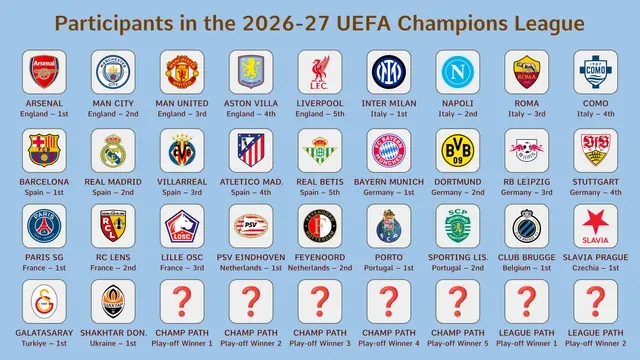
The UEFA Champions League returns in September 2026 with a revamped group stage format and several high-profile transfers already reshaping the competitive balance across Europe. Thirty-six clubs will compete in the opening phase, making this one of the most unpredictable editions in recent tournament history.
Format Changes for the 2026/27 Edition
UEFA introduced a modified league phase structure two seasons ago, and the 2026/27 edition builds on that foundation with minor but significant adjustments to seeding criteria and fixture scheduling. Clubs now play eight matches in the opening phase instead of six, increasing the total number of games before the knockout rounds begin.
The expanded format has been praised by smaller clubs who gain more exposure against elite opposition, while some larger clubs have raised concerns about fixture congestion ahead of domestic campaigns.
The Strongest Groups on Paper
Group composition this season has produced several genuinely difficult pools, with at least three groups containing four clubs that reached the knockout stages last year. Early simulations suggest that the dropout rate from traditionally strong clubs will be higher than in previous editions.
Group | Top Seed | Key Rival | Danger Club | Difficulty Rating |
A | Bayern Munich | Benfica | 9.4 / 10 | |
B | Manchester City | PSG | Atletico Madrid | 9.1 / 10 |
C | Arsenal | Inter Milan | Porto | 8.7 / 10 |
D | Barcelona | Borussia Dortmund | Ajax | 8.5 / 10 |
Key Players to Watch in the Group Stage
Several players arriving at new clubs this summer will make their Champions League debuts in new colours during the group stage. Their adaptation speed will be a defining factor in how their clubs perform across the eight opening fixtures.
Attackers With the Highest Expected Output
Expected goals models built on the last three Champions League seasons project these forwards as the most likely top scorers in the group phase, based on shot volume, position quality, and penalty frequency.
Erling Haaland, Manchester City: projected 6.8 xG across eight group matches
Kylian Mbappe, Real Madrid: projected 6.2 xG with high penalty conversion rate
Viktor Gyokeres, Arsenal: projected 5.9 xG after a strong domestic season
Lautaro Martinez, Inter Milan: projected 5.4 xG in a group favouring direct play
Midfielders Who Could Define Group Outcomes
Midfield control has historically been the strongest predictor of group stage progression in the expanded format, with ball retention and pressing metrics outweighing individual attacking output in several recent editions.
Pedri, Barcelona: highest passing accuracy in the Champions League last season at 93.2%
Rodri, Manchester City: leads all midfielders in ball recoveries per 90 minutes
Florian Wirtz, Bayern Munich: top creative midfielder by expected assists in Europe
Granit Xhaka, Bayer Leverkusen: most progressive carries per game among defensive midfielders
Clubs at Risk of Early Elimination
Not every traditional powerhouse enters the 2026/27 group stage in strong form. Several clubs are carrying injury concerns, managerial transitions, or significant squad departures that could make group stage progression more complicated than their seeding suggests.
Juventus, PSG, and Atletico Madrid each enter the tournament with notable squad instability following a summer of high-profile departures. Their placements in competitive groups amplifies that vulnerability considerably.
Fan Engagement and Viewing Trends
Streaming data from the 2025/26 Champions League showed a 22 percent increase in mobile viewing compared to two seasons prior, with the largest growth coming from Latin American audiences. Platforms operating across entertainment and sports verticals, including Meteoro casino br, have noted that Champions League matchdays consistently drive their highest weekly traffic spikes, reflecting the tournament's unique ability to capture broad audiences beyond traditional football markets.
Historical Group Stage Performance by Nation
A look at the last five Champions League editions shows a clear pattern of which domestic leagues produce the most group stage qualifiers and which produce the most surprise eliminations at the first hurdle.
League | Clubs Entered (5 seasons) | Knockout Rate | Average Points Per Club | Surprise Exits |
Premier League | 20 | 78% | 14.3 | 3 |
La Liga | 18 | 82% | 15.1 | 2 |
Bundesliga | 15 | 71% | 13.6 | 4 |
Serie A | 16 | 68% | 12.9 | 5 |
Ligue 1 | 10 | 60% | 11.4 | 4 |
Where to Follow Every Group Stage Match
All Champions League group stage highlights, full match replays, and live score updates for the 2026/27 season will be available in the Champions League section of DasFootball as each matchday concludes.