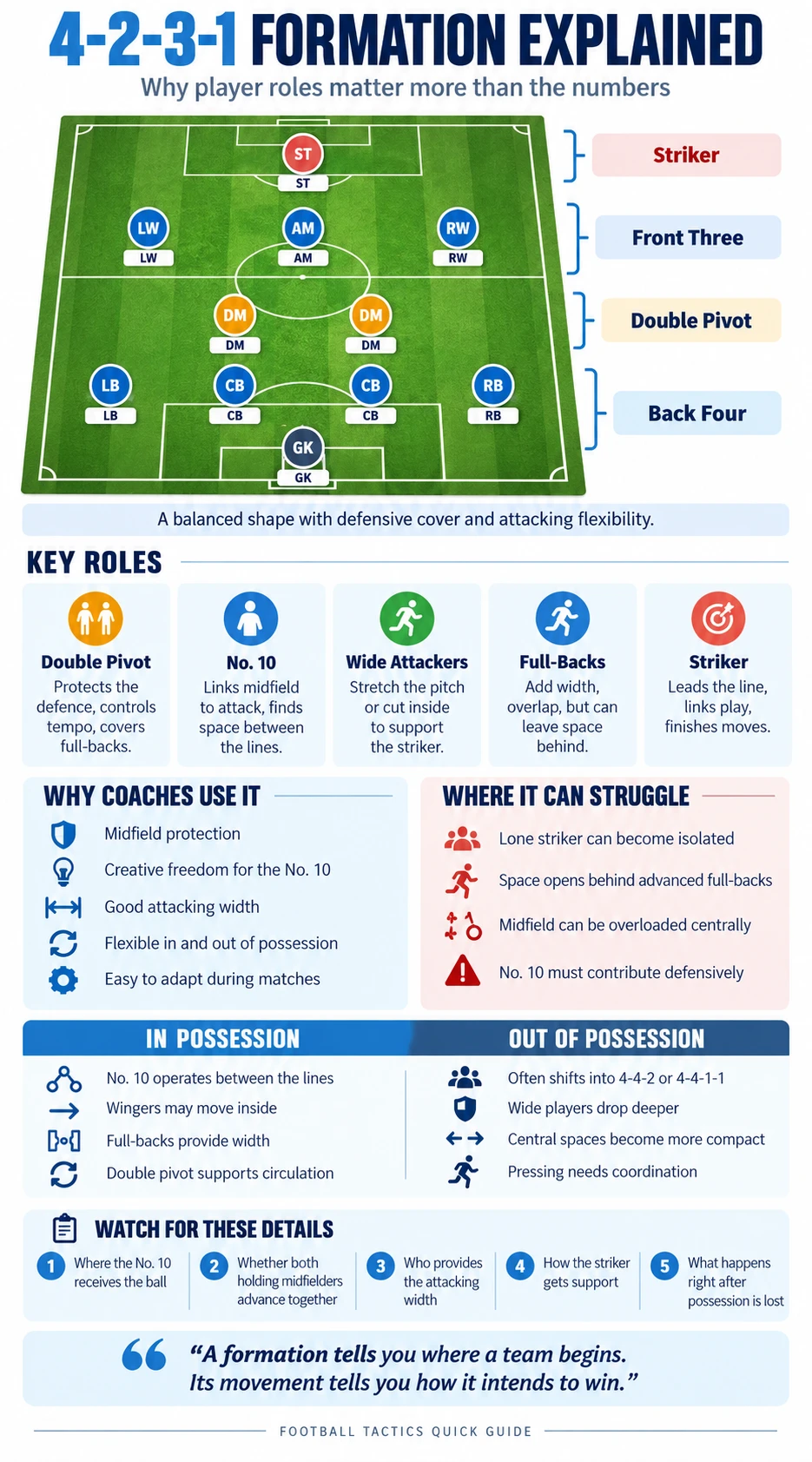
Football formations look wonderfully simple on a team sheet. Four defenders, two holding midfielders, three attacking midfielders and one striker. Job done, right? Not quite.
The 4-2-3-1 formation is a perfect example of why the numbers only tell half the story. Take a look at Match XI’s Chelsea lineup, for instance. Rather than focusing solely on the formation displayed, consider which midfielders can control possession, who provides the attacking width and which players are responsible for protecting the defence.
Those details can reveal far more about a team's intentions than a neat arrangement of eleven names.
And once the match starts, things become even more interesting.
What Is the 4-2-3-1 Formation in Football?
The 4-2-3-1 is a football formation built around four defenders, two deeper central midfielders, three attacking midfielders and a single centre-forward.
The goalkeeper is not included in the formation numbers.
Here's how the system is organised:
- 4 defenders: Two centre-backs and two full-backs.
- 2 central midfielders: Often called the double pivot, they support possession and protect the defence.
- 3 attacking midfielders: A central No. 10 supported by two wide attackers.
- 1 striker: The centre-forward leads the attack and occupies the opposition's central defenders.
The shape offers something most managers appreciate: a reasonable balance between attacking options and defensive security.
However, placing players in those positions does not automatically create an effective team.
What matters is how they move together.
The Double Pivot: The Engine Room Nobody Should Ignore
If you want to understand whether a 4-2-3-1 is working, start by watching the two central midfielders.
Their partnership is known as the double pivot.
One midfielder might collect the ball from the centre-backs, while the other looks for opportunities to carry it forward or join attacks. At other times, both must remain disciplined enough to prevent the opposition from breaking through the centre.