The modern stadium experience, as well as the home-viewing environment, has undergone a massive digital transformation over the past decade. Where halftime once meant grabbing another slice of pizza, arguing with friends about a questionable referee call, or simply sitting through a barrage of high-budget television commercials, today’s fans are engaging with their screens in fundamentally new ways.
Among the rising trends in sports culture, one shift stands out: the rapid rise of quick, casual mobile gaming during breaks in the action. From football stadiums across Europe to basketball arenas in North America, fans are turning to their smartphones during the 15-to-20-minute intermissions to keep their adrenaline flowing and stay entertained.
Here is a deep dive into why quick mobile games have become the ultimate halftime sidekick for modern sports fans.
Halftime is an essential component of professional sports, offering players a necessary physical break and coaches a strategic window to adjust their tactics. However, for the spectator, it represents a sudden shift in pace.
After 45 minutes of intense football action where every tackle, sprint, and shot on goal demands focus a 15-minute lull can feel surprisingly long. Broadcast networks traditionally fill this time with panel analysis and repetitive commercial blocks. While hardcore fans might hang on every analyst's word, a vast segment of the audience seeks immediate, interactive entertainment.
Mobile gaming perfectly bridges this engagement gap. Instead of shifting from high excitement to total passivity, fans can launch a quick game on their phone, maintaining a continuous loop of active participation throughout the broadcast window.
Not all mobile games are built for halftime. Deep, story-driven RPGs or complex strategy games require extended play sessions, deep concentration, and dedicated time things a spectator does not have while waiting for the second half to kick off.
Instead, the halftime gaming movement is powered by micro-games and casual titles designed for short bursts of play. Key characteristics of these games include:
● Instant Access: Sessions that can be started and finished within 30 seconds to two minutes.
● Low Learning Curve: Mechanics that are easy to pick up, requiring no complex tutorials.
● High Replayability: Bite-sized rounds that allow players to play three, five, or ten fast sessions before the referee blows the whistle to resume play.
This category includes everything from hyper-casual puzzle games and fast-paced sports simulators to casino entertainment. Many fans who want low-stakes, high-thrill action opt to play slots online, finding that the quick spin-and-win mechanics fit seamlessly into a brief halftime interval without demanding long-term strategic investment.
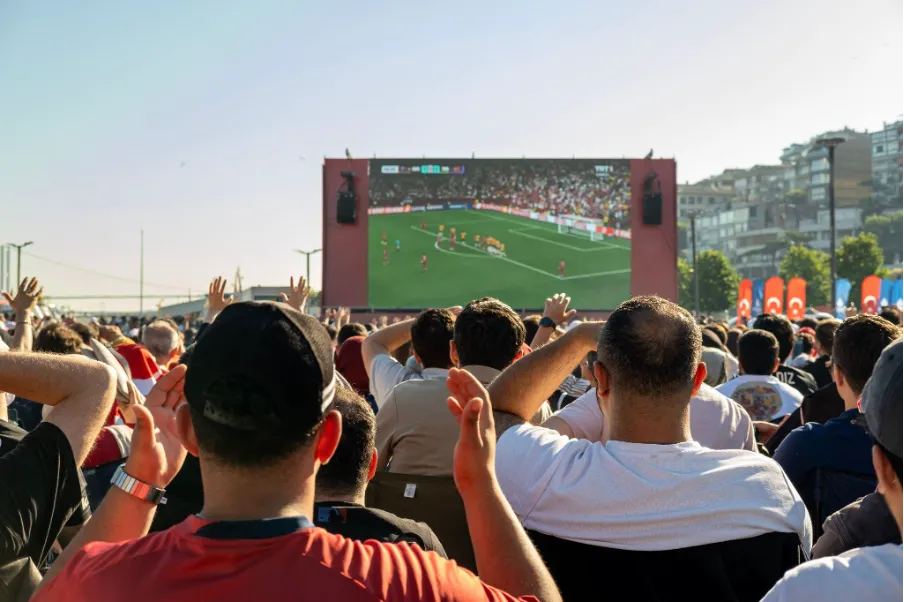
To understand the culture shift, visual media often highlights the contrast between the traditional stadium atmosphere and the modern hyper-connected fan experience.
Image: High-energy stadium environments provide the backdrop for personalized, mobile-first entertainment during breaks in play.
The phenomenon of using a smartphone while watching live television is known as second-screening. In the context of sports, second-screening has evolved from a distraction into an enhancement of the fan experience.
Sports produce high levels of dopamine and endorphins in viewers, particularly during close or high-stakes matches. When the whistle blows for halftime, that neurological stimulation takes a sudden dip. Engaging with a quick mobile game provides a secondary source of micro-rewards, keeping brain activity elevated until the main event returns.
Furthermore, mobile gaming offers a sense of control. While fans cannot influence the performance of their favorite team on the pitch, interactive mobile games give them direct agency over outcomes, successes, and scores during the break.
A major technical barrier that historically prevented stadium-based mobile gaming was network congestion. Anyone who attended a match a decade ago remembers the frustration of trying to load a basic webpage when surrounded by 50,000 other spectators attempting to use the same local cell tower.
The widespread rollout of 5G networks and advanced stadium Wi-Fi infrastructure has changed the landscape completely. Modern sports venues are built as hyper-connected hubs, equipped with high-density cell arrays that handle tens of thousands of simultaneous connections effortlessly.
At the same time, mobile developers have optimized games for low latency and minimal bandwidth consumption. The result is a seamless technical ecosystem where a fan in row 12 of a packed stadium can load a game instantly, play a few rounds, and put their phone back in their pocket just as the players walk back onto the field.
The trend of sports fans gaming at halftime is not happening in isolation. Sports clubs, leagues, and broadcasters actively encourage this behavior by integrating gamified elements into their official apps.
- Predictor Games: Fast halftime trivia or score prediction challenges that award points based on live match events.
- In-Stadium Rewards: Mobile mini-games that offer winning fans discounts on merchandise, food, or upcoming match tickets.
- Fantasy League Updates: Quick check-ins on fantasy lineups and rival scores across other matches taking place at the same time.
By embracing the reality that fans will look at their phones during breaks, sports organizations are turning halftime from a passive waiting period into an active touchpoint for fan engagement.
As mobile tech continues to evolve, the distinction between watching a sport and playing a game will become increasingly blurred. Augmented Reality (AR) mobile games may soon allow fans in the stadium to point their phone cameras at the pitch during halftime to participate in virtual penalty shootouts or interactive spatial challenges directly on the grass.
For now, the simple appeal of the quick mobile game remains undefeated. Whether it’s solving a puzzle, spinning a reel, or competing in a quick 60-second sports challenge, casual gaming has permanently claimed its spot in the matchday routine.
When the whistle sounds for halftime at the next big match, look around the stands or your own living room you will see a crowd that isn't just waiting for the match to restart, but one that is actively staying in the game.