
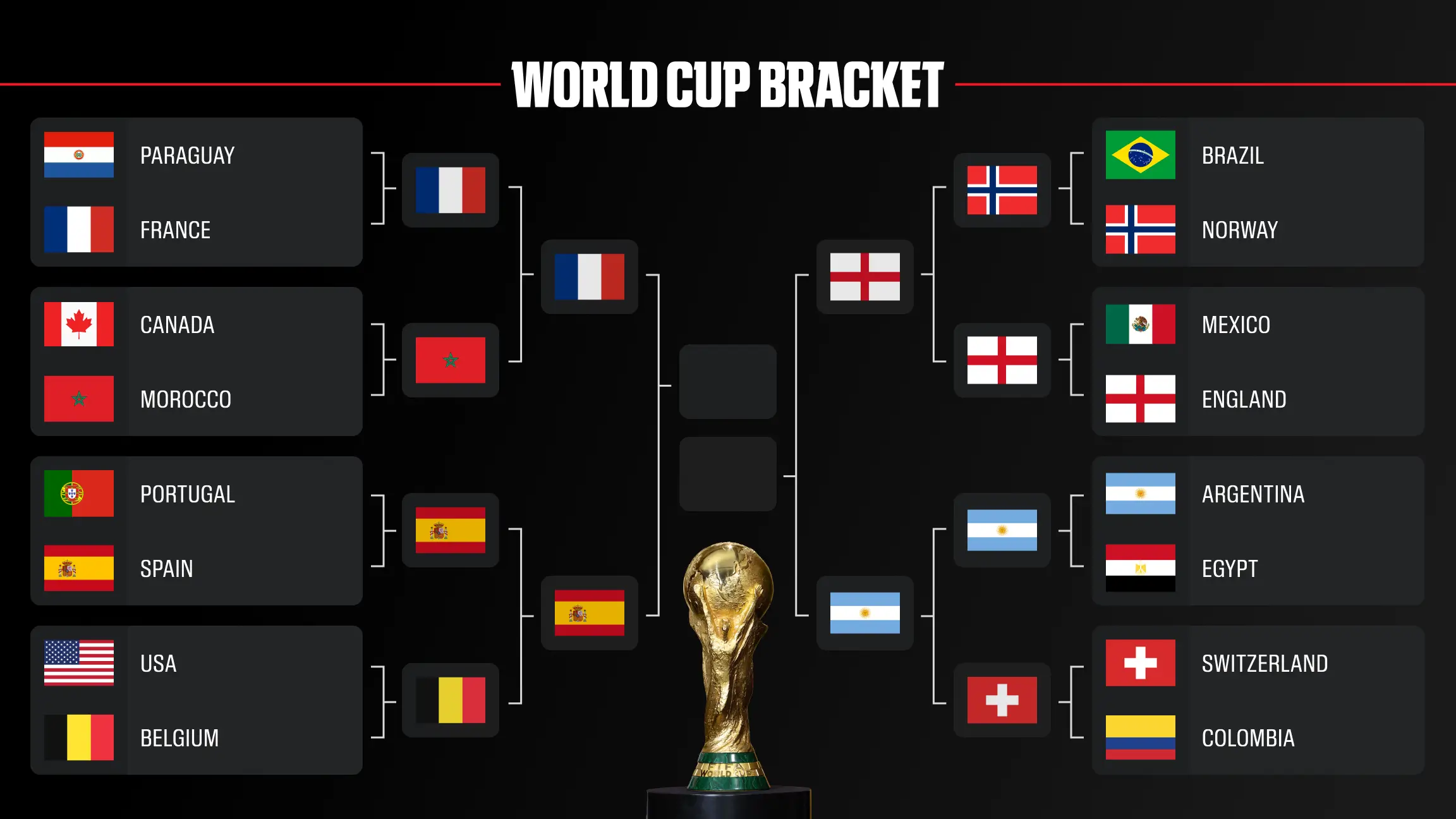
The 2026 World Cup has moved beyond group-stage arithmetic and into a semifinal lineup built for close reading. France will meet Spain on July 14, while England face Argentina on July 15. Those pairings were not produced by four routine quarterfinals. They emerged from different tests: French control, Spanish patience, English survival and Argentina’s ability to stretch a contest beyond 90 minutes.
The scorelines tell only part of the story. France beat Morocco 2-0 after a goalless first half. Spain needed an 88th-minute winner to defeat Belgium 2-1. England came from behind and required extra time against Norway, while Argentina also needed the additional period to put away Switzerland 3-1.
France Waited, Then Struck Twice
Morocco held France for an hour, but the match changed quickly once Kylian Mbappé scored in the 60th minute. Ousmane Dembélé added the second six minutes later, turning a tense quarterfinal into a controlled finish. France’s advantage was not simply individual quality; its press reduced Morocco’s clean exits and kept the game close to the African side’s penalty area.
That sequence matters before the meeting with Spain. France can win without dominating every phase, then accelerate when defensive distances begin to widen. Spain will try to deny those transition moments by keeping the ball, but possession becomes dangerous when a misplaced central pass releases Mbappé or Dembélé into open grass.
Spain’s Control Finally Met Resistance
Spain had gone through the tournament without conceding before Belgium broke that run in the quarterfinal. Fabián Ruiz put Spain ahead, Charles De Ketelaere equalized, and Mikel Merino decided the match late after substitute goalkeeper Senne Lammens failed to hold the initial effort. The 2-1 win showed why Spain remain difficult to eliminate, but it also exposed a less comfortable version of their football.
Luis de la Fuente’s team usually controls territory by circulating the ball until a defender steps out. Belgium resisted for long periods and forced Spain to defend a live game rather than manage a one-sided one. France will pose an even sharper question: can Spain sustain its high positioning without leaving its center-backs isolated against elite speed?
The Table Still Shapes the Knockout Story
The standings disappeared from the screen once the Round of 32 began, yet their influence remains embedded in the bracket. The first 48-team World Cup used 12 groups of four, with the top two in each group and the eight best third-place teams advancing. That format made goal difference, goals scored and cross-group comparisons part of the route to the final, not merely administrative details.